The trail
the beginning
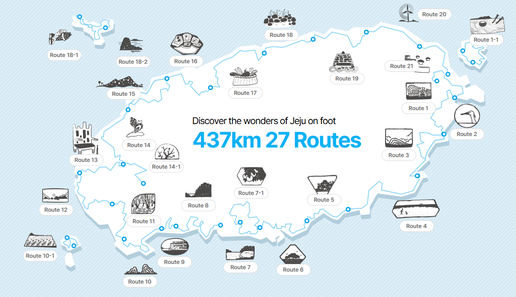
Ganse-dari - or "slow idler". On the small South Korean island Jeju, this expression stands for a relaxed, slow-paced approach to exploring its trails; a network of short trails, forming the Jeju Olle Trail, roughly following the island’s entire coastline.
Walking around Jeju, is a new experience for me. Not only is it my first longer hike in Asia, but also is it a more a cultural than a wilderness experience. A culture, I am not familiar with. Yes, I have been to South Korea before, twice in fact. However, that was many years ago and really just a short, yet highly enjoyable sneak peek.
So, when I first stumbled across Jeju Olle Trail, it instantly made its way up, close to the top of my bucket list.
Without any specific dates to go there, I initially start randomly checking the internet for information about the trail, followed by figuring out, how much time it would take me to walk the 437km walking trail. The research is not exactly structured; it’s mainly just browsing. Still, what I find out about the trail, makes it increasingly more promising so that I finally pluck up courage to book the flights from Zurich to Seoul.
The Planning and hiking
With the flights booked, my planning gathers up momentum. However, before focusing on the trail itself, I have to figure out a way to Jeju Island. Which isn’t a challenge. Seoul (where I arrive from Europe) to Jeju Island is the busiest passenger air route in the world. With more than 100 flights a day, I am spoilt for choice.
Since the trail goes past the airport, starting my trail at the airport is the natural choice. Clockwise or counterclockwise? While the trail is marked both ways, they are numbered clockwise, which is considered the “official” direction. That’s also the direction I walk the 27 trails.
Below some impressions and practical information. The information and impressions refere to the months of April and May. Things like weather or availabilty of accomodation will be different during other seasons.
Navigation
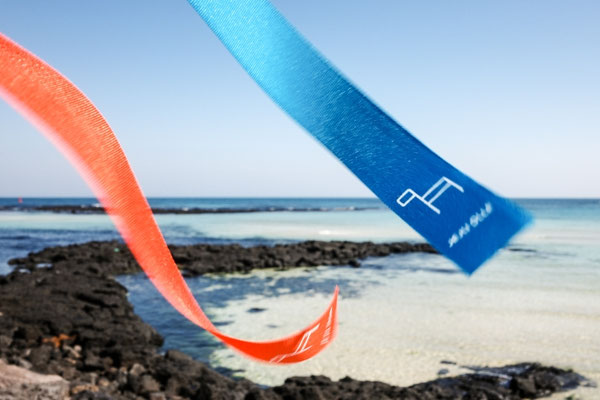
Marking is excellent. Ribbons, arrows and the Ganse (the slow idling Jeju pony) make navigation easy. Be it out in the "wild" or in the city. Blue markings show the clockwise direction, orange markings the opposite direction. While Google Maps is not always accurate, Kakao Maps and Naver Maps are useful tools for navigating as well. The trail is depicted on both of the mentionned maps.
Accommodation
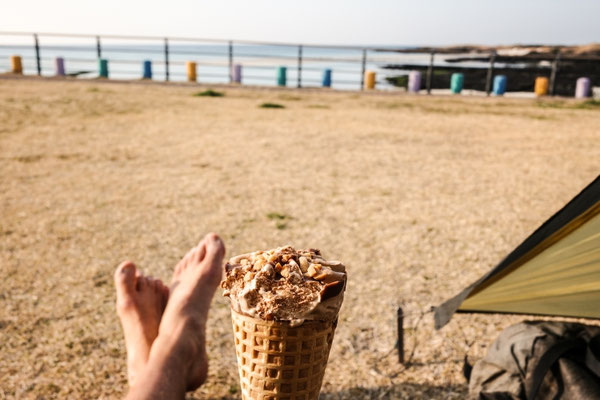
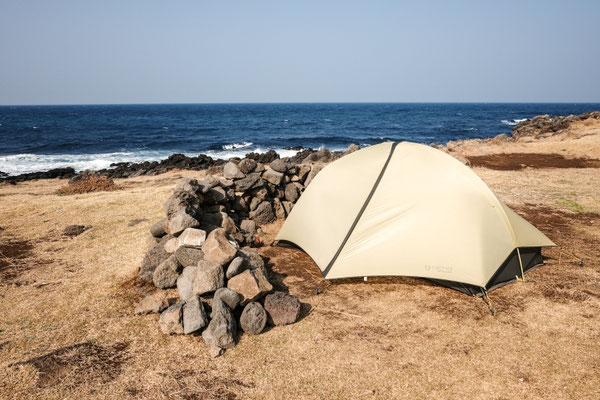
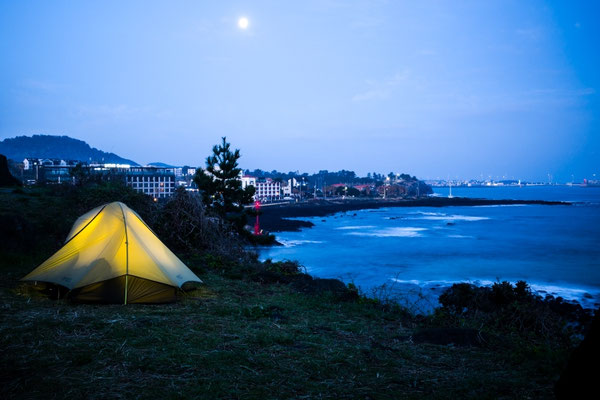
Camping is my accommodation of choice. Out of the 18 nights on the trail, I spend 16 in my tent or cowboy camping. There are some designated, free campsites every now and then to pitch tents. Neither of them is too busy. While some offer spectacular views, others are a bit tucked away. Generally, there's a toilet nearby.
While neither officially permitted nor forbidden, freedom camping is a grey area. The Jeju Olle Trail is not remote. Suitable places out of sight from houses or the road are rare. Applying the "pitch late, leave early" method helps staying out of unlikely but still possible trouble.
Jeju, being a very touristic island, offers a lot of other accomadation, if camping is not possible. Especially in larger cities like Jeju or Seogwipo, there is plenty of affordable choice. Hostels are very cheap and generally pleasant to stay in.
Resupply
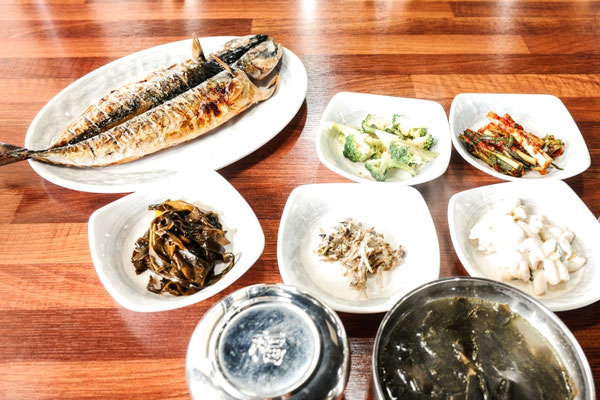
Whenever I have the chance, I eat in restaurants. There is an abundance of restaurants along the trail. Most of them offer a lot of delicious food for little money. More often than not I am the only guest making these restaurants a great place for a quick rest, plan the next section or charge the phone. For the little snack inbetween, convenince stores (some of them 24/7) are scattered all over the island.
Tab water is drinkable. While some of the many public toilets are rather filthy, I never encounter any problem filling my bottle from their sink.
Climate
The weather in March and April is pleasant with an average daily high of 15 degrees Celcius and mostly sunny days. Only twice I encounter rain. Coming from a long, cold Swiss winter, this feels like summer! My thin sleeping bag is warm enough.
I can't say if it is the norm but visibility is generally limited by haze or mist.
Obviously, there is much more to write about the trail. It would go beyond the scope of this page. While walking, I was writing a daily blog, which has plenty of other, far more detailed information.
looking back and some Final thoughts
Three weeks in South Korea. On the little volcanic island called Jeju, Its volcano, Hallasan, throning in the middle. Walking a trail called the Jeju Olle. Olle - meaning driveway or path to a house. And it certainly felt a bit like this. Exploring the island on foot, at times off the beaten tracks, up close and personal, gave me an insight of the Jeju island life. At least that's what I think or hope. Coming from a different culture, far away from South Korea, there are things I don't understand, never will. And that's something I fully accept.
Jeju Olle, with the Ganse, the lazy Jeju pony, showing the path also stands for the slow approach of exploring the island. It was a new experience for me. And while a bit challenging at times to slow down, embrace the moment, just idling, overall, I think it had a positive effect on me; despite the trails often being not trail but rather (slightly boring) road walking, the scenery nice but a far cry from the natural beauty of Switzerland, New Zealand or Norway, I felt splendid while on the trail. In fact I think I found the pleasure again in walking, a pleasure which I lost lately. Maybe it were the short days, no pressure to cover long distances, just living and walking in the here and now, focussing on the details, The favourable weather helped, so did (on a more practical side) the lack of mosquitoes, ticks and other unwanted animals
Obviously, there's always the backside of the medal. I'll randomly start with surveillance cameras: Everywhere. On the roads, parks, even along hiking trails. Rather than making feel safe and secure, the feeling of being under surveillance constantly was rather unpleasant.
Rubbish: there are no public rubbish bins on Jeju. Which is fine for me. So are all the no littering signs. However, when I looked down at the beaches, the water or up into the farmland, there's rubbish everywhere. Plastic, fishing nets, you name it. An ugly, depressing sight and in stark contrast to all the no littering signs. Rendering them somewhat cynical.
Tinted windshields of the cars: basically all cars in South Korea have tinted windows - even the windshields. You can't see the driver, you can't make eye contact. As a walker, something I find a bit disturbing and unsafe. I'm still wondering how this can be legal. On a side note: usually I lake waving at the drivers. Not so in South Korea. Not so in Korea. Why should I, if I can't see them.
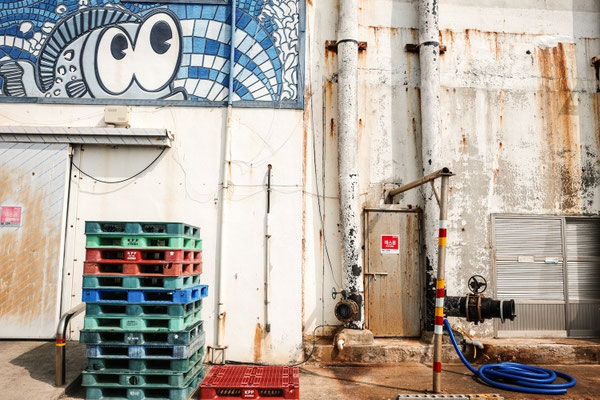
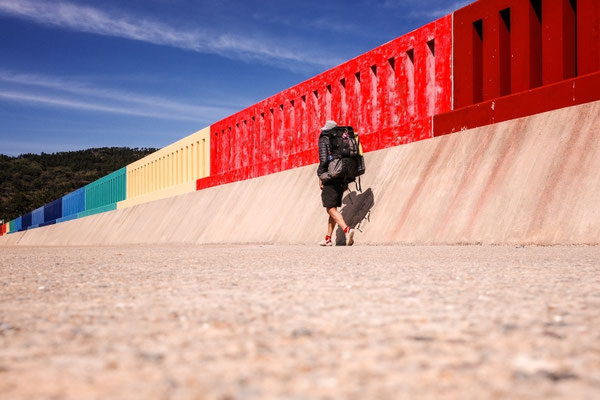
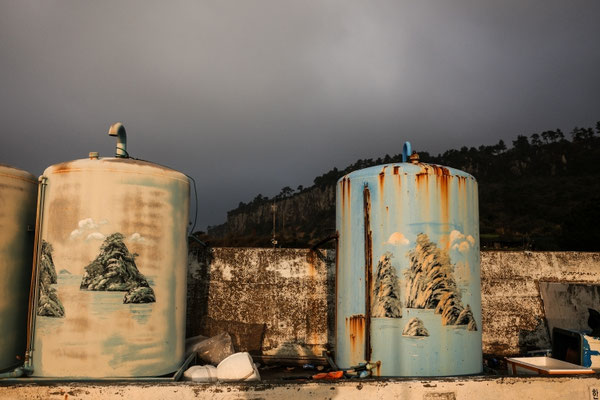
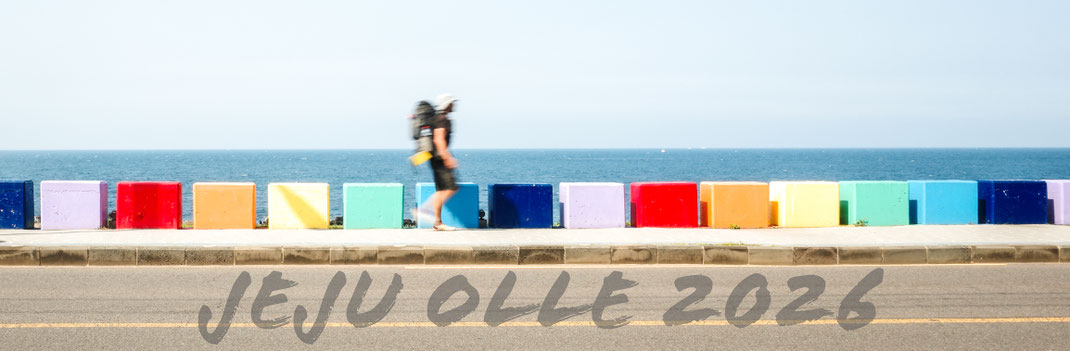
Spatial planning and architecture in general: spatial planning doesn't really seem to exist. Houses scattered everywhere, big wind turbines flanking a cafe and a hotel. It's not nice to look at. So are the buildings in general. A lot of concrete, little charm. Kilometers walking along fake wooden fences. Made out of concrete, painted to make them look like wood. It bothered me more than it probably should have. In the beginning at least. Until I changed my mindset and focused on the positive side of the thing, the other shiny side of the medal. The Koreans, in there own way, are somehow able to turn something rather ugly into something rather sweet. With lovely decorations and creative paintings and lots of dedication, the Jejuans turn a run down concrete structure or ugly seawall becomes a little piece of art.
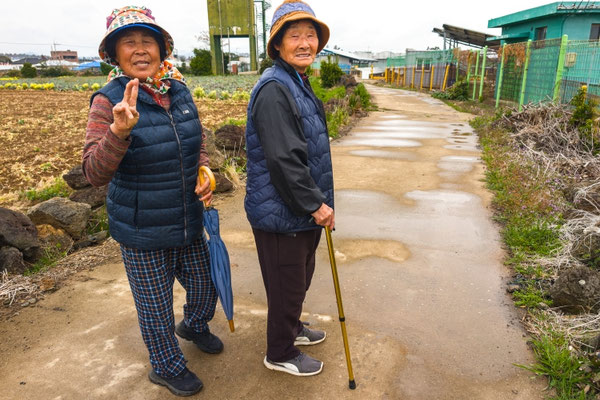
The people of Jeju. Overall, they seem happy, enjoying their life. I enjoy watching them. They also seemed to enjoy my company. A lot of talking along the way, even more food that was offered to me. I felt welcome in Jeju. Then there are all the Jeju Olle volunteers putting life into the the trail. The ladies at the information booths, the walking mates. I wasn't expecting so much volunteering, so much dedication. Always polite, always happy. Together with all the other Jejuans, they massively added to attractiveness of my walk.
Nonetheless, I don't think I would hike it again (to be fair I say that after most of my longer walks). While I thoroughly enjoyed it, it's not my natural habitat. The great outdoors, the views, the solitude. Things that I appreciated the longer the more during the walk. With the camping that I did on the trail, I compensated a little bit for an otherwise extremely civilized trail.